
When your skin breaks out in red, itchy, flaky patches - and no one can explain why - it’s easy to blame stress, soap, or bad luck. But for millions, the real culprit is something you touch every day: an allergen hiding in your lotion, jewelry, or even your phone case. This isn’t just a nuisance. It’s contact dermatitis, and it’s often avoidable - if you know what to look for.
What Exactly Is Contact Dermatitis?
Contact dermatitis is a skin reaction caused by direct contact with a substance. There are two types: irritant (from chemicals like bleach or detergent) and allergic (triggered by your immune system). Allergic contact dermatitis, or ACD, makes up about 20% of all cases. It doesn’t show up right away. It takes hours, sometimes days, for your skin to react. That’s why it’s so easy to miss the connection between your rash and that new wristwatch, shampoo, or work glove.
The process starts when tiny chemicals - called haptens - sneak through your skin’s barrier. They latch onto proteins in your skin, and your immune system starts treating them like invaders. Special cells called Langerhans cells carry these fake threats to your lymph nodes, where T-cells get activated. Later, when you touch the same substance again, those T-cells trigger inflammation: redness, swelling, blisters, and intense itching.
What Are the Most Common Allergens?
Not all allergens are created equal. Some affect nearly everyone. Others are rare. But a few stand out - and they’re hiding in plain sight.
- Nickel: The #1 offender. Found in jewelry, belt buckles, zippers, coins, and even smartphone cases. Affects 14.7% of people tested in the U.S., and up to 17.4% of women. The EU banned nickel in jewelry since 2004 - and saw a 25% drop in cases.
- Fragrance mix: Not just perfume. Added to lotions, shampoos, detergents, and even baby wipes. Affects 1-4% of the population. The standard test uses a mix of 8 chemicals, but many products contain dozens more.
- Cobalt chloride: Often paired with nickel in metal alloys. Found in blue pigments, batteries, and some cosmetics.
- Thimerosal: A preservative once common in vaccines and eye drops. Still shows up in some topical products.
- Balsam of Peru: A natural resin used in scented products, cinnamon, citrus, and even some foods. Surprisingly, it’s also in tobacco and coffee.
- Cocamidopropyl betaine: A foaming agent in shampoos, body washes, and facial cleansers. One Reddit user reported her hand eczema vanished after avoiding this ingredient.
These five account for over half of all positive patch tests. But there are thousands of possible allergens. A hairdresser might react to ammonia in dye. A nurse might react to latex gloves. A mechanic might react to epoxy resins. The trigger depends on your life - not just your skin.
How Do You Find Out What’s Causing It?
Guessing won’t work. You need a test - and the gold standard is patch testing.
Unlike skin prick tests (which check for food or pollen allergies), patch testing looks for delayed reactions. Here’s how it works:
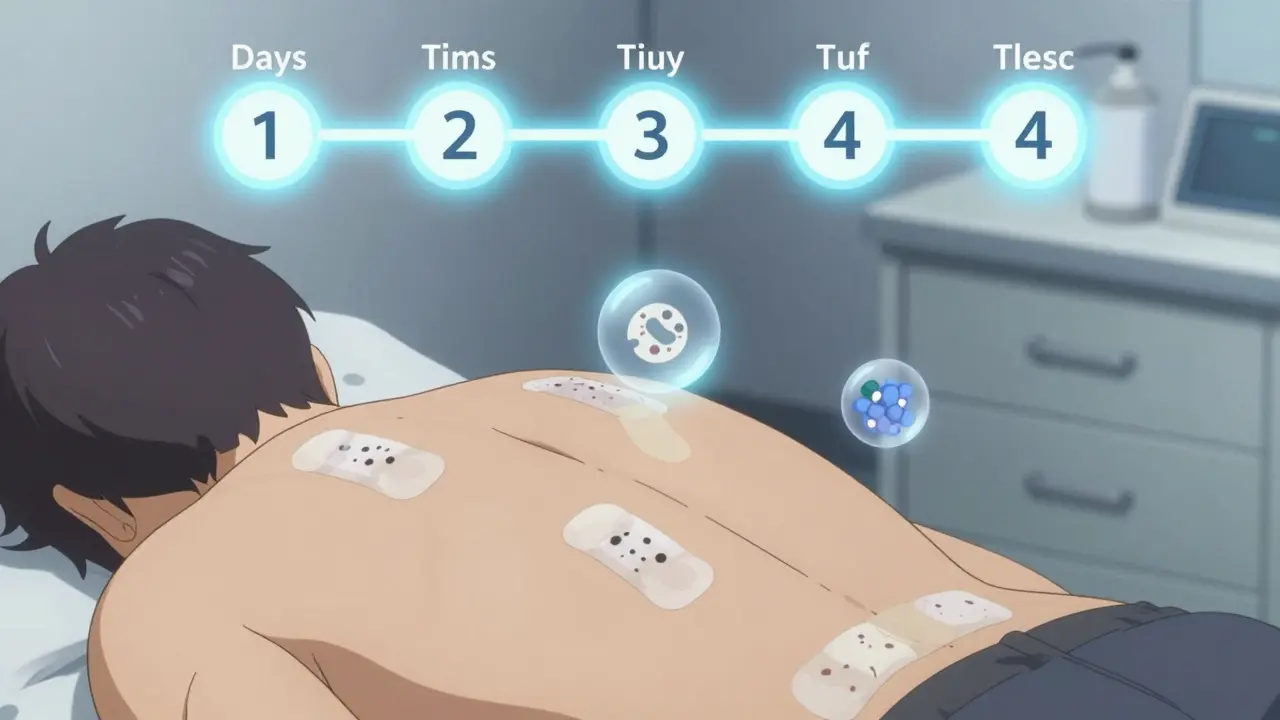
- You visit a dermatologist on a Monday. Tiny patches, each containing a different allergen, are taped to your back.
- They stay on for 48 hours. No showering. No sweating. No removing them.
- On Wednesday, the patches are removed. The doctor checks for redness or swelling.
- On Friday (96 hours total), you return for a final reading. Some reactions show up late.
The standard test, called the TRUE Test, checks 29 common allergens. But it’s not perfect. Studies show it misses up to 30% of cases. That’s why experts now recommend expanded testing - especially if you work in high-risk jobs like hairdressing, healthcare, or construction.
Expanded panels can include 70-100 allergens. For example, if you’re a hairdresser, your doctor might test for paraphenylenediamine (PPD) - a dye ingredient that causes severe rashes. If you use a lot of hand sanitizer, they might test for quaternium-15 or formaldehyde releasers.
And here’s the kicker: patch testing changes treatment in 60-70% of cases. One study found that patients who got tested and avoided their allergens saw an 82% drop in symptoms. Without testing? Most people just keep using the same products - and keep getting rashes.
What If Patch Testing Doesn’t Find Anything?
Some people get negative results - even when they’re sure something’s causing their rash. That’s frustrating. But it’s not hopeless.
First, consider timing. If you were using steroids or antihistamines before the test, your skin might not react. Wait at least two weeks after stopping them.
Second, your allergen might not be on the standard panel. Fragrance allergies are tricky. The TRUE Test includes a “fragrance mix,” but it doesn’t cover all 26 regulated fragrance allergens in the EU. You might need a separate test for linalool, citronellol, or geraniol - ingredients common in “natural” products.
Third, look at your environment. A 2023 survey found that 47% of patients struggled to identify hidden sources of allergens. Your shampoo might be fine, but your conditioner has the same ingredient. Your gloves might be latex-free, but the powder inside contains talc with traces of nickel.
Some clinics use advanced techniques like thin-layer chromatography to break down complex products (like lotions or cleansers) and test each component separately. It’s not widely available - but it’s an option if you’ve hit a wall.
How Do You Actually Avoid These Allergens?
Knowing you’re allergic to nickel is useless if you don’t know where to find it. Avoidance isn’t about avoiding one product - it’s about rewriting your daily routine.
The Contact Allergen Management Program (CAMP), run by the American Contact Dermatitis Society, helps. After a positive patch test, you get a personalized list of safe products. They’ve cataloged over 18,452 items - from shampoo to sneakers - that don’t contain your trigger. It’s like a shopping guide for your skin.
Here’s how to start:
- Read labels. Look for ingredient lists, not marketing claims like “hypoallergenic” or “fragrance-free.” Those terms aren’t regulated. Check for the actual chemical name.
- Use the CARD database. The Contact Allergen Replacement Database (CARD) is free and updated yearly. Search your allergen - it’ll suggest safe brands.
- Switch slowly. Replace one product at a time. If you swap your entire skincare routine overnight, you won’t know what worked.
- Test new products. Put a drop on your inner forearm. Wait 48 hours. If no reaction, use it.
- Check your electronics. Phones, smartwatches, and laptops often contain nickel or cobalt. Use a silicone case. Avoid direct skin contact.
Occupational exposure is another big piece. If you’re a nurse, ask your employer to switch from latex to nitrile gloves. If you’re a mechanic, request barrier creams. OSHA requires employers to accommodate workers with diagnosed allergies - but you have to report it first.

Why Don’t We Have Better Regulations?
In the EU, 26 fragrance allergens must be labeled on cosmetics. Nickel is restricted in jewelry. Canada bans certain preservatives. But in the U.S.? There’s no federal law requiring manufacturers to disclose allergens or restrict dangerous chemicals. The Safe Cosmetics Act has been stuck in Congress since 2021.
This means you’re on your own. You’re not just managing a skin condition - you’re navigating a system that doesn’t protect you.
What’s Next for Diagnosis and Treatment?
Science is catching up. Researchers are testing blood markers like IL-18, which rises with ACD severity. Others are developing molecular tests that detect allergens bound to skin proteins - potentially more accurate than patch tests.
By late 2025, the TRUE Test will expand from 29 to 80 allergens, adding emerging triggers from green cosmetics and personal electronics. The EU is phasing out animal testing entirely by 2027. Non-animal methods are now the standard for chemical safety testing.
But here’s the truth: none of these advances replace patch testing. Not yet. It’s still the most reliable, affordable, and widely available tool we have. And for now, it’s your best shot at getting your life back.
Real People, Real Results
One woman had a rash on her neck for five years. She tried everything: steroids, natural creams, diet changes. Then she got patch tested. Result: nickel in her necklace clasp. She switched to a titanium chain - and her skin cleared up in two weeks.
A construction worker got rashes on his hands every winter. He thought it was dry skin. Patch testing revealed epoxy resin in his gloves. He switched brands - and hasn’t had a flare-up since.
These aren’t rare stories. They’re common. And they happen because someone finally asked: What am I touching?
Can contact dermatitis go away on its own?
Yes - if you stop touching the allergen. But if you keep using the same soap, jewelry, or lotion, the rash will keep coming back. Avoidance is the only cure. Medications like steroids can calm the flare-up, but they don’t fix the root cause.
Is patch testing painful?
No. It’s not like a needle or a blood draw. The patches are taped to your back - you won’t feel anything. The only discomfort comes later, if you react. Then your skin might itch or sting, but it’s usually mild and temporary.
Can I do patch testing at home?
No. Home patch tests aren’t reliable. The allergens need to be applied under controlled conditions, and results must be interpreted by a trained dermatologist. False positives and negatives are common without professional oversight. Skip the DIY kits - they’re not worth the risk.
How long does it take to see improvement after avoiding an allergen?
Most people notice improvement within 2-4 weeks. Some see changes in just a few days. But if the allergen was embedded in your skin for months or years, it can take up to 8 weeks for full healing. Patience matters.
Are natural or organic products safer?
Not necessarily. Many natural ingredients - like tea tree oil, lanolin, balsam of Peru, and essential oils - are common allergens. Just because a product says “natural” doesn’t mean it’s gentle on sensitive skin. Always check the ingredient list.
Can I still use makeup if I have contact dermatitis?
Yes - but choose carefully. Look for products labeled “fragrance-free” and “preservative-free.” Avoid anything with alcohol, parabens, or formaldehyde releasers. Use the CARD database to find safe brands. Many dermatologists recommend mineral-based makeup as a starting point.

Comments
Ethan Zeeb March 3, 2026 AT 07:52
Been dealing with this for years. Thought it was stress until I switched my phone case. Nickel. Just nickel. One silicone case later? Skin cleared up in 10 days. No meds. No creams. Just stop touching the damn metal.
Darren Torpey March 3, 2026 AT 14:54
Bro. This is the kind of post that makes you wanna hug a dermatologist. I didn’t know my ‘natural’ shampoo had balsam of Peru in it. I thought ‘organic’ meant ‘won’t turn my arms into a crime scene.’ Turns out, tea tree oil is basically poison for my skin. I’m switching to unscented castile soap and living my best life now. 🙌
Lebogang kekana March 4, 2026 AT 13:24
Man, I just read this and I’m like… this is why Africa needs better access to patch testing. I’ve seen women in my village with rashes for YEARS because they can’t afford a dermatologist. And don’t even get me started on the fake ‘herbal remedies’ that make it worse. This info? It’s gold. Spread it. Share it. Translate it. Someone’s life depends on this.
Jessica Chaloux March 5, 2026 AT 11:04
OMG I CRIED. I’ve been dealing with this since college. I thought I was just ‘sensitive.’ Turns out it was cobalt in my cheap earrings. I threw them all out. Bought silver. Now I’m not scratching my neck raw at 3am. Thank you. I’m so emotional right now. 😭
Mariah Carle March 7, 2026 AT 05:04
It’s not just dermatitis. It’s a metaphysical question: What are we touching when we touch the world? The skin is the boundary between self and other. When allergens breach it, they don’t just cause inflammation-they reveal the fragility of our autonomy in a world of invisible toxins. We are not just victims of chemistry. We are participants in a silent war against corporate opacity. And yet… we keep buying the same lotion. Why? Because convenience is the new opiate.
Justin Rodriguez March 8, 2026 AT 19:24
Just wanted to add: if you’re a nurse or work in healthcare, check your gloves for talc powder. It often has trace nickel. Switch to powder-free nitrile. Also, hand sanitizer? Look for quaternium-15 or formaldehyde releasers. They’re everywhere. I’ve helped 3 coworkers identify their triggers just by asking what they use daily. You don’t need a PhD. Just curiosity and a label reader.
Raman Kapri March 9, 2026 AT 13:27
This article is a classic example of Western medical overdiagnosis. In India, we’ve been using coconut oil and turmeric for centuries. Why do you need a $500 patch test? Maybe your skin is just reacting to processed chemicals. Stop blaming nickel. Blame the food industry. Blame the FDA. Blame capitalism. Also, ‘hypoallergenic’ is a marketing scam. Always read the label. Always. End of discussion.
Chris Beckman March 10, 2026 AT 03:05
lol i had a rash for 3 years and it was from my laptop keyboard. nickel. i never even thought about it. now i use a silicone skin on it. also i found out my toothpaste had cocamidopropyl betaine. i was using ‘sensitive’ toothpaste. the label lied. i’m not mad. i’m just… disappointed. also i think the government is hiding the truth. why isn’t this on the news? someone should sue.
Levi Viloria March 10, 2026 AT 05:41
As someone who grew up in a household where ‘if it stings, it’s working’ was the skincare philosophy, this blew my mind. My mom used to rub lemon juice on my eczema. I thought I was tough. Turns out I was just slowly poisoning my skin. Now I use CAMP’s database to pick out laundry detergent. I’m not a nerd. I’m a survivor.
Zacharia Reda March 11, 2026 AT 21:38
So you’re telling me the reason I can’t wear my favorite watch is because it’s not ‘fashionable enough’ to be safe? I get it. We live in a world where aesthetics trump biology. But hey - at least now I can say I have a titanium watch. It’s basically a flex. Also, I tested 12 products before finding one that didn’t trigger me. Took 8 months. Worth it. You’re not broken. You’re just allergic to capitalism.
Tobias Mösl March 12, 2026 AT 15:52
THIS IS A GOVERNMENT COVER-UP. Nickel is in EVERYTHING because the CDC wants us sick. Why? To sell more steroid creams. The FDA approves 90% of allergens because they’re paid by Johnson & Johnson. Patch testing? It’s a trap. They want you to think you’re ‘in control’ while they poison your water, your food, and your phone. I’ve been tracking my rashes since 2017. It’s not coincidence. It’s systematic. The EU banned nickel? They’re the good guys. We’re the lab rats.
tatiana verdesoto March 13, 2026 AT 07:21
I’m a nurse and I’ve had 3 patients in the last month who didn’t know their rash was from their own shampoo. One was using ‘fragrance-free’ baby wash. Turned out, it had balsam of Peru. We need to educate more. I start every new patient with, ‘What’s on your skin?’ Not ‘What’s wrong with you?’ It changes everything. You’re not alone. I see you.
Stephen Vassilev March 14, 2026 AT 02:57
It is imperative to note, however, that the absence of regulatory oversight in the United States constitutes a gross violation of public health ethics. The Safe Cosmetics Act has been languishing since 2021 due to corporate lobbying, and the FDA’s voluntary reporting system for adverse reactions is statistically insignificant. Furthermore, the reliance on patch testing - a method with a 30% false-negative rate - is not merely inadequate, it is negligent. One must question: why are we still using 1970s diagnostic protocols in a 2025 world? The answer lies in institutional inertia. And inertia, as we know, is a form of violence.
Deborah Dennis March 15, 2026 AT 03:36
Ugh. Another ‘here’s how to fix your skin’ post. I’ve been doing this for 15 years. No patch test, no miracle. Just more chemicals. I gave up. Now I just wear long sleeves. And ignore everything. Maybe I’m just broken.
Shivam Pawa March 15, 2026 AT 18:01
From Mumbai: In India, we use neem, amla, and turmeric for everything. But modern products? They’re full of hidden allergens. I tested 4 shampoos. 3 had cocamidopropyl betaine. One had fragrance mix. I switched to plain glycerin soap. No rash in 6 months. Simple. No need for expensive tests. Just read the label. And avoid ‘natural’ claims. They’re lies.