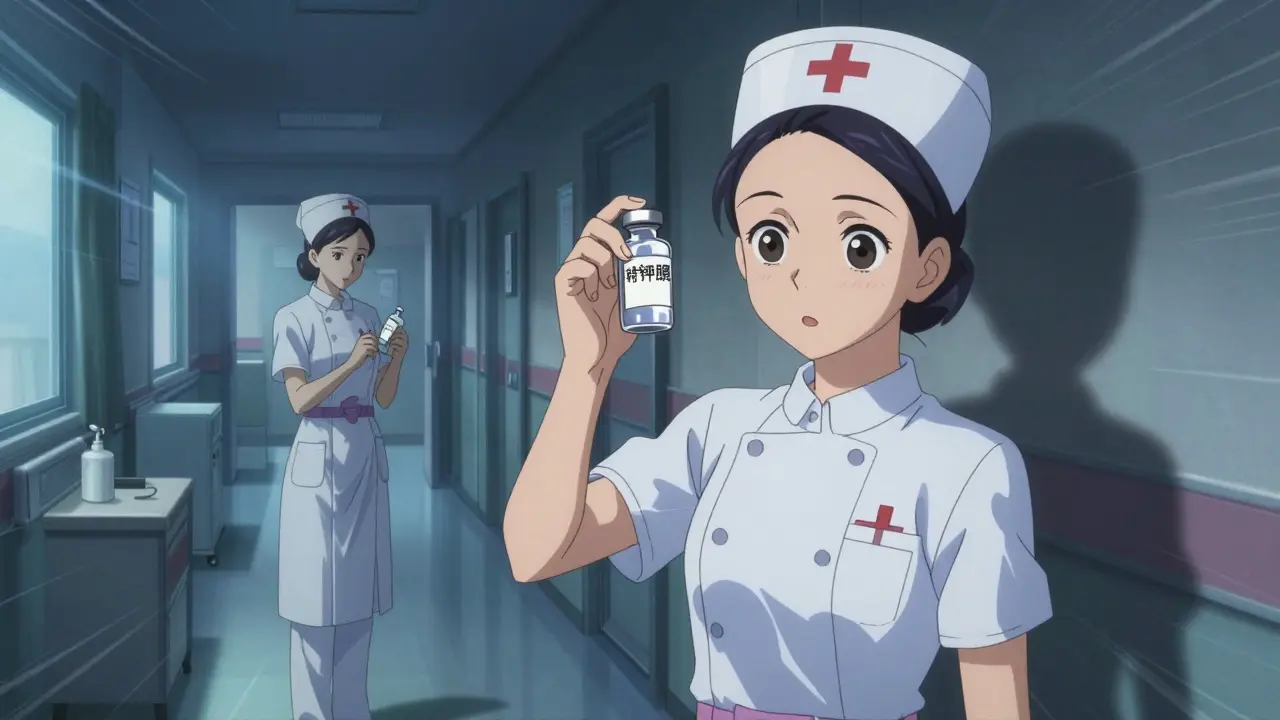
When a nurse walks into a patient’s room to give IV insulin, a dose of potassium chloride, or a neuromuscular blocker, they’re not just handing over a drug-they’re handling a potential life-or-death mistake. One wrong decimal point, one misread label, one rushed check, and the consequences can be immediate, irreversible, and fatal. That’s why high-alert medications demand more than routine care. They demand a second set of eyes, done right.
What Makes a Medication High-Alert?
High-alert medications aren’t necessarily more dangerous than others. They’re dangerous because even small errors can lead to major harm. The Institute for Safe Medication Practices (ISMP) defines them as drugs with a high risk of causing significant patient injury or death if used incorrectly-even if mistakes happen at the same rate as with other meds. Think of it like driving a sports car: you don’t crash more often, but when you do, the damage is worse. The 2024 ISMP list identifies 19 categories of high-alert medications used in hospitals. These include:- Insulin (especially IV infusions and pushes)
- Concentrated potassium chloride (1 mEq/mL or higher)
- Concentrated potassium phosphate
- Neuromuscular blocking agents (like succinylcholine or rocuronium)
- IV heparin (including flushes over 100 units/mL)
- Direct thrombin inhibitors (argatroban, bivalirudin)
- Chemotherapeutic agents
- Parenteral nutrition (TPN)
- Injectable narcotic patient-controlled analgesia (PCA) pumps
- Sodium chloride solutions above 0.9%
Why Double Checks Matter-And Why They Often Fail
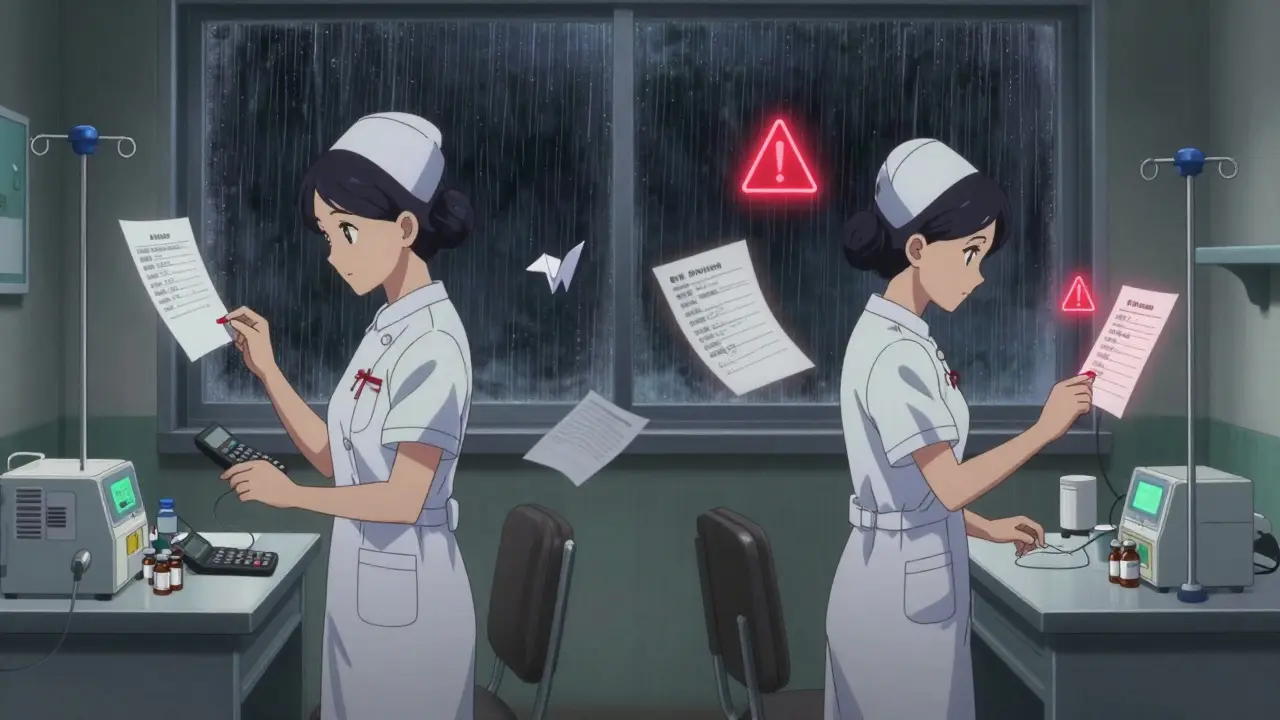
The standard safety step for these drugs is the independent double check (IDC). It’s simple in theory: two licensed clinicians verify the medication separately, then compare notes. But in practice, it’s often broken. A 2017 study in the Journal of Patient Safety found that when done correctly, IDCs prevent 87% of errors. But when nurses do the check together-talking, looking at the same screen, or one telling the other what to expect-the error detection rate drops to just 32%. Why? Because the second person doesn’t think for themselves. They’re just confirming what they heard. The Veterans Health Administration (VHA) calls this “simultaneous checking,” and it’s not a double check-it’s a fake one. True independence means:- Each person checks alone, without talking
- Each person verifies all five rights: right patient, right medication, right dose, right route, right time
- They don’t share their findings until both are done
- They compare results only after independent verification
What Exactly Should You Check?
A double check isn’t just glancing at the label and the MAR. It’s a full verification of five critical elements, as defined by VHA Directive 1195 (2024):- Right patient: Use two forms of identification-name and date of birth, not room number or bed.
- Right medication: Match the drug name on the vial or pump to the electronic order. Watch for look-alike names like hydralazine and hydroxyzine.
- Right dose: Verify the concentration, total volume, and calculated dose. For insulin, that means checking the units per mL and the total units ordered. For potassium, it means confirming it’s not a concentrate meant for dilution.
- Right route: Is this supposed to go IV? Or is it meant to be swallowed? Giving a concentrated IV drug orally can kill.
- Right time: Is this dose due now? Is it part of a continuous infusion? Is the pump programmed correctly?
- Pump settings (rate, volume, bolus limits)
- Line compatibility (is this drug compatible with the IV fluid?
- Expiration dates and storage conditions
Which Medications Actually Need a Double Check?
Not every high-alert drug needs a manual double check. That’s the biggest mistake hospitals make. The ISMP says bluntly: “Manual independent double checks are not always the optimal strategy.” Why? Because they’re slow, inconsistent, and prone to human error if overused. A nurse doing 20 double checks a shift isn’t thinking-she’s on autopilot. The smart approach is to use IDCs only for the highest-risk situations:- IV insulin infusions-always. One error can cause hypoglycemic brain damage.
- Concentrated potassium chloride-always. It’s lethal in small amounts.
- Neuromuscular blockers-always. No muscle movement means no breathing.
- IV heparin infusions-yes, especially if not on a smart pump.
- Chemotherapy-yes, in pediatric and oncology units.
- TPN and CRRT solutions-yes, because of complex electrolyte balances.
How to Do It Right: A Real-World Workflow
Here’s how a good double check works, step by step:- The nurse pulls the medication from the automated dispensing cabinet (ADC).
- They scan the medication and patient wristband in the eMAR system.
- They take the med to a quiet area-no distractions.
- They verify all five rights independently, writing down their findings.
- They call for a second clinician (RN or pharmacist).
- The second person does the same check, alone, without hearing the first person’s results.
- Only after both are done, they compare notes. If anything doesn’t match, they stop.
- Both sign the eMAR electronically.
- For continuous infusions, the next shift must re-verify before taking over.
Technology Can Help-But Not Replace
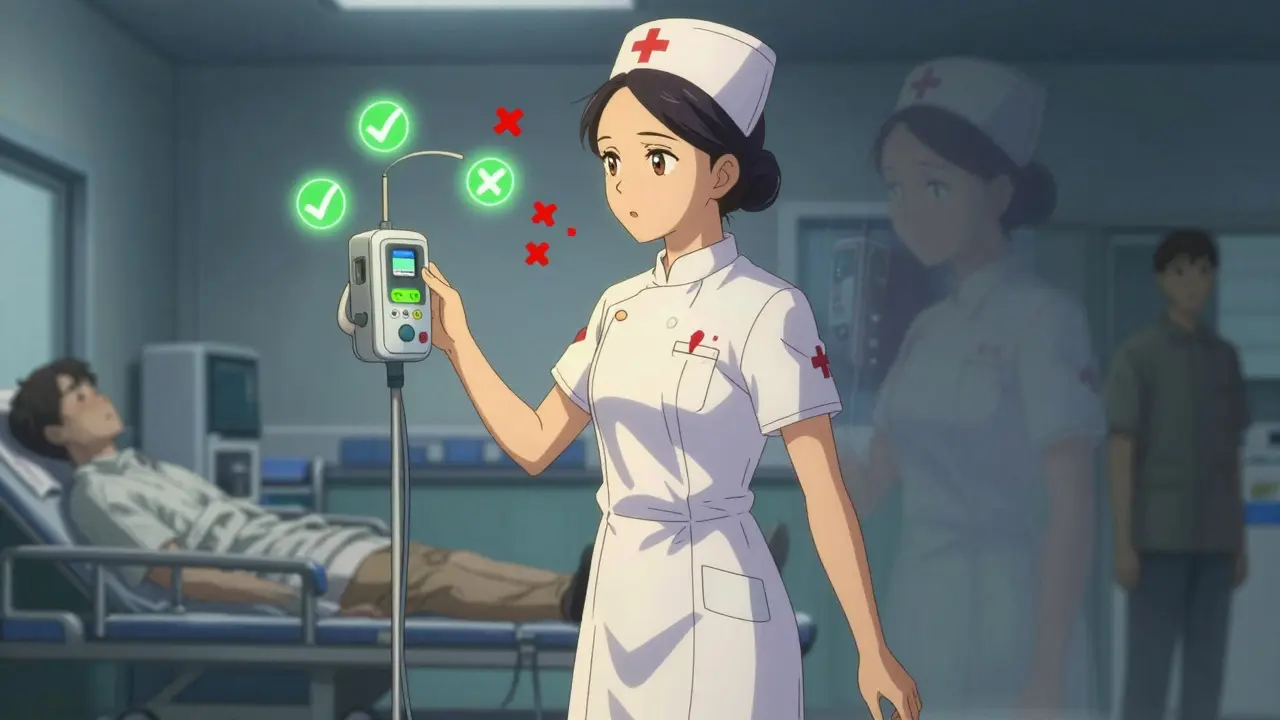
Smart pumps with dose error reduction systems (DERS) are now standard in 65% of large hospitals. These devices flag incorrect doses before they’re programmed. E-prescribing systems can block dangerous combinations. Barcoding ensures the right drug goes to the right patient. But tech isn’t perfect. A pump can’t tell if the patient’s kidney function has changed and the dose needs adjusting. It won’t catch a mislabeled vial. It won’t know if the patient’s weight was entered wrong. That’s why human verification still matters-for the highest-risk meds. The best systems combine technology with targeted double checks. A 2023 ECRI analysis found hospitals using both smart pumps and limited IDCs reduced errors by 63%. Those relying only on manual checks? Only 42%.Why Some Nurses Resist-and How to Fix It
Frontline staff often hate double checks. They say:- “There’s no time.”
- “The second nurse is always busy.”
- “We’ve never had a problem before.”
- Build double-check time into shift planning
- Train staff on why it matters, not just how to do it
- Recognize nurses who catch errors
- Stop punishing delays-reward safety
What’s Next for Medication Safety?
The future isn’t more manual checks-it’s smarter ones. AI-assisted verification tools are being tested in 12% of academic medical centers. Risk-stratified protocols are being developed-stricter checks for elderly, renal-impaired, or pediatric patients. The High-Alert Medication Safety Coalition, formed in 2024 by ISMP, ASHP, AHA, and The Joint Commission, is pushing for national standardization. And by 2028, ECRI predicts manual double checks will drop by 40% as technology fills the gaps. But here’s the truth: no algorithm will ever replace a trained, focused human who asks, “Wait-does this make sense?” For now, the safest hospitals don’t do double checks because they’re required. They do them because they know: in medicine, the smallest mistake can be the last one.What are the most common high-alert medications that need a double check?
The top five medications requiring independent double checks are IV insulin, concentrated potassium chloride, neuromuscular blocking agents, IV heparin infusions, and chemotherapeutic agents. These drugs have narrow therapeutic windows-small errors can cause death. Even though other high-alert meds like TPN or PCA pumps are also risky, these five are consistently flagged as highest priority by ISMP and major health systems.
Can one nurse do a double check alone?
No. A true independent double check requires two licensed clinicians who verify the medication separately and without communication until both are done. If one nurse checks the medication and then calls another to just sign off, that’s not a double check-it’s a formality. The second person must independently verify all five rights and pump settings before comparing results.
Do all hospitals require double checks for the same medications?
No. While the ISMP 2024 list is the industry standard, individual hospitals set their own policies. The VHA requires double checks for all 19 high-alert categories. Providence Health System limits them to high-risk infusions and controlled substances. Some community hospitals only require them for insulin and potassium. The key is consistency: whatever policy you follow, you must enforce it correctly.
What happens if there’s no second nurse available during an emergency?
In emergencies like code blue or rapid sequence intubation, double checks may be bypassed-but only under strict protocols. Many hospitals allow one licensed clinician to administer a high-alert med in life-threatening situations, but they must document the reason, have a second person verify the dose immediately afterward, and report the deviation. This is a safety exception, not a loophole. The goal is to prevent delays without sacrificing safety.
Are electronic signatures enough for a double check?
Electronic signatures in the eMAR are required for documentation, but they’re not enough on their own. The double check must happen before the signature. If two nurses sign the same eMAR entry without independently verifying the medication, dose, and patient, it’s just a digital stamp. The physical verification-reading labels, checking concentrations, calculating doses-must occur first. Technology supports safety, but it doesn’t replace human judgment.

Comments
Joni O January 19, 2026 AT 06:38
Just saw a nurse give insulin without a double check last week. Patient went hypo, had to be rushed to ICU. We’re not talking ‘oops’ here-we’re talking code blue. I swear, if we just did the damn check, half these disasters wouldn’t happen. 🙏
Nishant Sonuley January 20, 2026 AT 16:07
Look, I get it-double checks are tedious, but let’s be real: if you’re not doing them properly, you’re not a nurse, you’re a glorified pill pusher. I’ve seen so-called ‘double checks’ where one person reads the label and the other just nods like a bobblehead. That’s not safety, that’s theater. The VHA got it right: independent verification, no talking, no assumptions. If your hospital treats this like a compliance checkbox, you’re one typo away from a lawsuit and a funeral. And yes, I’ve seen the paperwork. It’s always the same: ‘No issues found.’ Right. 🤡
Robert Davis January 21, 2026 AT 03:18
Everyone’s so focused on double checks, but nobody’s talking about the real problem: hospitals are understaffed and overworked. You can’t expect a nurse who’s done 12 shifts in a row to care about verifying potassium concentrations when they’re running on caffeine and regret. The system’s broken-not the nurses. Fix the staffing ratios first. Then we can talk about double checks. Otherwise, you’re just blaming the person holding the syringe while the executives sip their lattes.
Eric Gebeke January 21, 2026 AT 08:34
Let me tell you about the time I caught a 10x insulin overdose because the second nurse was scrolling TikTok during the ‘double check.’ She didn’t even look at the vial. Just signed. And now? The hospital won’t admit they had a near-miss. They call it ‘an isolated incident.’ Isolated? It’s the norm. This isn’t about training. It’s about culture. And our culture is toxic. If you don’t believe me, ask the nurse who quit last month after her patient died from a ‘misread label.’ She didn’t quit because she was burnt out. She quit because she couldn’t look herself in the mirror anymore.
Jake Moore January 22, 2026 AT 09:42
Biggest myth: double checks are slow. Nah. The slow part is when you skip them and then spend 3 hours in the ER stabilizing someone who shouldn’t be there. I work at a community hospital-we do double checks on insulin, KCl, and NMBs. Takes 90 seconds. We’ve had zero errors in 18 months. The trick? Make it part of the rhythm. Don’t treat it like an interruption. Treat it like breathing. And yes, we use smart pumps too-but tech doesn’t replace a human who asks, ‘Wait, does this make sense?’
Ryan Otto January 23, 2026 AT 14:57
Let’s be honest: this whole ‘double check’ paradigm is a distraction manufactured by the pharmaceutical-industrial complex to justify higher staffing costs and perpetuate bureaucratic control. The real issue is the systemic dehumanization of clinical care. The ISMP is not a neutral body-it’s funded by vendors who profit from compliance software. Why are we still using paper MARs in 2024? Why aren’t we deploying AI-driven real-time pharmacokinetic modeling? Because the system prefers performative safety over actual innovation. Double checks are a placebo. The cure is automation. But nobody wants to admit that.
Max Sinclair January 23, 2026 AT 21:53
Love the post. Really well-researched. I’ve seen both sides-the rushed checks and the proper ones. The difference is night and day. I work in pediatrics, and we do double checks on everything, even if it’s not on the ‘official’ list. One time, we caught a mislabeled vial that was supposed to be epinephrine but was actually dopamine. If we hadn’t double-checked? The baby wouldn’t have made it. It’s not about being paranoid. It’s about being responsible. And yeah, it takes time. But so does grieving.
Praseetha Pn January 24, 2026 AT 02:26
Okay but have y’all noticed that every single time someone gets hurt, the hospital blames the nurse? Meanwhile, the pharmacy sends out vials with blurry labels, the EHR glitches and swaps doses, and the admin cuts staffing by 20% but still wants 100% compliance? 🤡 This isn’t about ‘human error’-it’s about a system that’s designed to fail and then punish the people trying to keep it from collapsing. I’ve seen a nurse cry because she was written up for a double check ‘failure’… while the CEO got a bonus for ‘cost savings.’ Wake up. This isn’t medicine. It’s capitalism with a stethoscope.
Robert Cassidy January 24, 2026 AT 15:21
Double checks? Please. In America, we don’t need them. We have the best healthcare system in the world-according to the ads. If you can’t handle a little potassium, maybe you shouldn’t be a nurse. Back in my day, we had one nurse for every 15 patients and we still saved lives. Now everyone’s crying because they have to look at a label twice? This is why America’s falling apart. We’ve turned safety into a religion and competence into a burden. Get back to basics. Trust your training. Stop the performative nonsense.
Dayanara Villafuerte January 25, 2026 AT 23:06
Y’all need to chill. 😌 I’m from Puerto Rico and we do double checks like it’s a dance-slow, intentional, and with respect. We even have a little chant before we verify: ‘Right patient, right med, right dose, right time, right route.’ It’s not magic. It’s mindfulness. And guess what? We have fewer errors than half the hospitals in the mainland. It’s not about more rules. It’s about more heart. 💖
Andrew Qu January 27, 2026 AT 06:04
One thing no one mentions: the second checker often has less experience. I’ve had new grads do my ‘double check’ because I was busy. That’s not safety-that’s a liability. The solution? Rotate who does the check. Don’t always have the senior nurse do it. Let the new person verify the senior’s work. That way, everyone stays sharp. And if you’re the senior? Don’t just nod. Ask them to explain why they think it’s right. If they can’t, you’ve got a problem.
Tyler Myers January 27, 2026 AT 08:38
Let’s be real: this whole ‘double check’ thing is just a cover for hospitals not wanting to invest in better tech. Smart pumps can catch 95% of errors. Why are we still making nurses do manual math in 2024? It’s laziness disguised as safety. And don’t even get me started on the fact that the same nurses who do these checks are the ones getting yelled at when something goes wrong. They’re the sacrificial lambs in a broken system. Wake up, people. This isn’t about procedure. It’s about power.
rachel bellet January 28, 2026 AT 14:16
Per VHA Directive 1195, Section 4.2(b), the independent verification protocol requires dual authentication of all five rights, including verification of the calculated dose against the pharmacy’s prepared dose, with documentation in the eMAR under two distinct credential identifiers. Failure to comply constitutes a Level 3 safety violation under Joint Commission Standard MM.04.01.01. The use of non-validated verification methods, including verbal confirmation or simultaneous review, is explicitly prohibited and may result in accreditation sanctions. Further, per ISMP 2024 Advisory Bulletin #2024-07, the omission of concentration verification for potassium chloride infusions is classified as a ‘critical root cause’ in 89% of fatal hyperkalemia events. Compliance is not optional. It is non-negotiable.