
Ever filled a prescription and been shocked by the price-even though you thought your insurance covered it? You're not alone. The reason often lies in something called a formulary tier. It's not a secret code. It's a system used by health insurance plans to decide how much you pay for your meds. And if you don't understand it, you could be paying way more than you need to.
What Is a Formulary, Anyway?
A formulary is just a list. But it’s not a list of your favorite movies or songs. It’s a list of prescription drugs your insurance plan agrees to cover. Not every drug is on it. And even if a drug is on the list, it might be placed in a different tier-each with its own cost to you.Think of it like a grocery store with different pricing zones. Some items are on sale (Tier 1). Some are regular price (Tier 2). Others are premium or specialty (Tier 3 or higher). Your job? Figure out which zone your drug is in before you pay.
Formularies aren’t random. They’re built by Pharmacy Benefit Managers (PBMs)-companies like CVS Caremark, Express Scripts, and OptumRx-that manage drug benefits for insurers. They look at things like: is there a cheaper generic? Is it clinically effective? Did the drugmaker offer a discount? Then they slot it into a tier.
Almost every health plan in the U.S. uses tiers. Medicare Part D? Tiers. Employer plans? Tiers. Even plans bought through Healthcare.gov? Tiers. The system’s been around since the 1980s, but it’s gotten more complex. Today, most plans have four or five tiers. And that’s where things get confusing.
Tier 1: The Low-Cost Zone
Tier 1 is your best friend if you’re on meds long-term. This is where most generic drugs live. Generics are chemically identical to brand-name drugs but cost way less-often 80% cheaper. And because insurers love generics, they put them in Tier 1 to encourage use.
What do you pay? Usually $0 to $15 for a 30-day supply. Some plans even make Tier 1 generics free. Medicare Part D calls this the "lowest copayment" tier. In 2022, Medicare beneficiaries paid an average of just $1.27 per Tier 1 prescription. That’s not a typo. One dollar and twenty-seven cents.
Examples? Lisinopril for high blood pressure. Metformin for diabetes. Atorvastatin for cholesterol. All generics. All Tier 1. If your doctor prescribes one of these, you’re in the sweet spot.
Tier 2: The Preferred Brand Zone
Tier 2 is where you find brand-name drugs that your plan considers "preferred." These aren’t generics. But they’re still favored because they’ve been negotiated down in price-often through rebates between the drugmaker and the PBM.
Cost? Typically $20 to $40 for a 30-day supply. Higher than Tier 1, but still manageable. Medicare Part D calls this the "medium copayment" tier.
Why is a brand-name drug in Tier 2 and not Tier 3? Because it’s either the most effective option for a condition, or it has a better safety profile than cheaper alternatives. Or maybe the drugmaker offered a big discount. Either way, your plan still wants you to use it.
Example? Amlodipine (Norvasc) for high blood pressure. Even though a generic exists, some plans still put the brand in Tier 2 because it’s been shown to work better for certain patients.
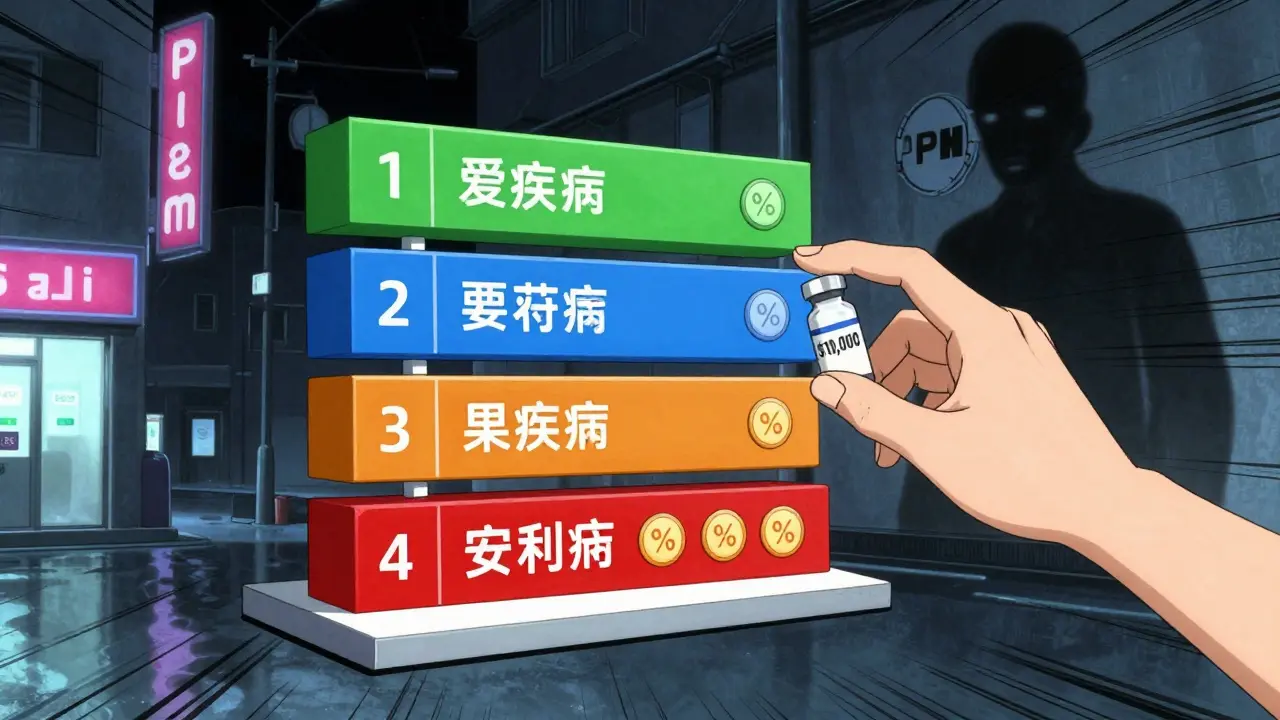
Tier 3: The Non-Preferred Brand Zone
Tier 3 is where things get expensive. This is for brand-name drugs that your plan doesn’t prefer. Maybe there’s a cheaper generic available. Maybe the drugmaker didn’t offer a good rebate. Or maybe there’s a similar drug in Tier 2 that works just as well.
Cost? Usually $50 to $100 for a 30-day supply. That’s a big jump from Tier 2. In 2022, Medicare beneficiaries paid an average of $58.72 per Tier 3 prescription-nearly 50 times more than Tier 1.
Example? Omeprazole (Prilosec) brand. The generic (omeprazole) is Tier 1. But if your doctor prescribes the brand, you’re stuck in Tier 3. Same active ingredient. Same effect. But you pay more.
Here’s the kicker: your doctor might not know which tier your drug is in. That’s why it’s up to you to check. Always ask: "Is there a cheaper alternative on Tier 1 or 2?"
Tier 4 and 5: Specialty Drugs and the Cost Cliff
Some plans go beyond Tier 3. Tier 4 and Tier 5 are for specialty drugs-expensive medications used for complex conditions like cancer, rheumatoid arthritis, multiple sclerosis, or rare genetic diseases.
Instead of a flat copay, these tiers usually use coinsurance. That means you pay a percentage of the total drug cost-like 25%, 33%, or even 50%. A drug that costs $10,000 a month? You could owe $3,000.
Humana’s 2023 plan documents show Tier 4 can be 25-33% coinsurance. Tier 5? Up to 50%. That’s not a typo. Half the cost of a $15,000 drug could be on you.
Why do these exist? Because these drugs are expensive. But here’s the problem: for many patients, there’s no alternative. If your only treatment is in Tier 5, you’re stuck. And 41% of patients report delaying or skipping doses because of these costs, according to the Patient Advocate Foundation.
Non-Formulary: The No-Go Zone
Non-formulary drugs aren’t on the list at all. Your insurance won’t cover them. Period. You pay 100%.
Why? Maybe the drug is too new. Maybe it’s not proven to be better than existing options. Maybe the manufacturer refused to negotiate. Or maybe it’s just not considered medically necessary.
Example? A brand-new weight-loss drug that just hit the market. Or a rare cancer drug that costs $200,000 a year. If it’s not on the formulary, you’re on your own.
But here’s a lifeline: you can ask for an exception. If your doctor says you absolutely need the drug and there’s no alternative, they can file a prior authorization request. Sometimes, it works. In 2022, the Medicare Rights Center documented cases where patients successfully appealed to get a Tier 3 drug moved to Tier 2-cutting their monthly cost from $142 to $45.
Why Do Tiers Change? (And How to Stay Ahead)
Formularies aren’t set in stone. They change. Quarterly. Sometimes without warning.
A drug you’ve been taking for years could suddenly move from Tier 2 to Tier 3. Or worse-get kicked off the formulary entirely. In 2022, 43% of commercial plan members had at least one drug moved to a higher tier during the year.
Here’s how to stay in control:
- Check your formulary every January when open enrollment starts.
- Use your insurer’s online drug cost tool (like Humana’s Drug Cost Finder or Medicare’s Plan Finder).
- Ask your pharmacist: "Is this drug still on my plan’s formulary? What tier is it?"
- Keep a list of your meds and their tiers. Update it every time you refill.
Don’t wait until you’re at the pharmacy counter to find out you owe $150. That’s how people get stuck.
What You Can Do: Fight Back Smartly
You have rights. Here’s how to use them:
- Ask for a generic. If your drug is in Tier 2 or 3, ask if a generic version exists. If yes, request it.
- Ask for a tier exception. If your drug is non-formulary or in a high tier, your doctor can submit a prior authorization. They’ll need to explain why it’s medically necessary.
- Use mail-order or 90-day fills. Many plans offer lower copays for longer supplies.
- Check for patient assistance programs. Drugmakers often have savings cards or free drug programs for low-income patients.
- Call your insurer. The 1-800 number on your card is there for a reason. Ask: "Why is this drug in this tier? Can I appeal?"
And if you’re on Medicare, remember: insulin is capped at $35 a month regardless of tier. That’s thanks to the Inflation Reduction Act of 2022. Other drugs may follow.
Bottom Line: Know Your Tier, Save Your Money
Insurance formulary tiers aren’t meant to confuse you. They’re meant to guide you toward cheaper, effective drugs. But when you don’t understand them, they become a trap.
The smartest patients aren’t the ones who take whatever’s prescribed. They’re the ones who ask: "Is there a cheaper option? What tier is this on? Can we switch?"
With a little research and a few phone calls, you can avoid paying hundreds-or thousands-more than you should. And that’s worth the effort.

Comments
Tasha Lake February 11, 2026 AT 00:42
Okay, so let me get this straight-PBMs are the middlemen who negotiate with drug companies, and then insurance companies use that data to slap drugs into tiers? And we’re supposed to trust that they’re optimizing for our health, not their profits? I get that generics are cheaper, but if a brand-name drug works better for me and has fewer side effects, why should I be punished for it? It’s like the system incentivizes quantity over quality. And don’t even get me started on how formularies change without notice. One month you’re on Tier 2, next month you’re paying 3x more. No warning. No grace period. Just a surprise bill at the pharmacy. This isn’t healthcare-it’s a financial obstacle course with a stethoscope.
Also, why do we let PBMs run this whole thing? They’re private corporations with zero accountability. If this were a public utility, we’d riot.
tl;dr: The system is rigged. Knowledge is power, but power is expensive.
Sam Dickison February 12, 2026 AT 12:33
Just wanna say I appreciate this breakdown. I’ve been on metformin for 8 years-Tier 1, $0 copay. Never even thought about why. Turns out it’s because it’s the OG generic for diabetes and PBMs know it’s effective as hell. Same with lisinopril. But when my doc switched me to a new blood pressure med last year? Tier 3. $87/month. I called my insurer, asked for a prior auth, and they moved it to Tier 2 after my doctor sent in the clinical rationale. Took 11 days. Worth it.
Pro tip: Always ask your pharmacist if there’s a generic equivalent. They know the formulary better than your insurance rep. And if you’re on Medicare, use the Plan Finder. It’s clunky, but it works.
Also, mail-order saves money. I get 90-day fills. Half the trips to the pharmacy. Less stress. More sleep.
Ryan Vargas February 13, 2026 AT 03:31
Let me tell you something they don’t want you to know: formulary tiers aren’t about cost containment. They’re about control. The real architects of this system aren’t pharmacists or doctors-they’re the actuaries at CVS Caremark and OptumRx who get bonuses based on how much they reduce drug spending. And guess what? Reducing spending doesn’t mean finding cheaper alternatives. It means pushing patients off drugs entirely. Or forcing them into coinsurance hell.
Did you know that in 2021, a single PBM collected over $12 billion in rebates from drug manufacturers? And less than 10% of that was passed on to consumers? The rest? Kept. As profit.
And the ‘exception’ process? A joke. You fill out 7 forms, wait 4 weeks, get denied, appeal, get denied again, then finally, after 3 months, they approve it… and your drug’s been discontinued anyway.
This isn’t healthcare. It’s a surveillance capitalism experiment with pill bottles. And we’re the lab rats.
Also, insulin is capped at $35? That’s not generosity. That’s a PR stunt. They’ll find another way to gouge you. Mark my words.
PS: If your doctor prescribes a Tier 3 drug, they’re probably being paid by the pharma rep. Ask for the generic. Always.
Brett Pouser February 14, 2026 AT 02:49
I’m a nurse in rural Ohio, and I see this every day. People show up with tears in their eyes because they skipped their meds to afford groceries. One woman told me she split her 30mg omeprazole pill in half because the brand was Tier 3 and she couldn’t afford it. She didn’t even know the generic was $3. I helped her switch. She cried again-but this time from relief.
Doctors don’t always know the tiers. Pharmacists do. But they’re rushed. So if you’re paying more than $50 for a common med, ask: ‘Is there a Tier 1 or 2 alternative?’
And if you’re on Medicare, use the 1-800 number. Seriously. I’ve seen people save $200/month just by calling and asking for a tier exception. No magic. Just persistence.
Also-patient assistance programs exist. Merck, Pfizer, AbbVie-they all have them. You just have to ask. No shame. You’re not asking for charity. You’re asking for your health.
Don’t let the system make you feel guilty for needing medicine. You deserve it.
Simon Critchley February 14, 2026 AT 10:00
Right then, lads and lasses, buckle up, because this is where I drop the mic 😎
Formulary tiers? More like ‘formulary tyranny’. PBMs are basically the NHS’s evil twin-no public oversight, no transparency, and a whole lotta ‘we’ll make you pay for your own survival’. And don’t even get me started on coinsurance for specialty drugs. 50%? That’s not a copay-that’s a hostage situation.
And here’s the kicker: the same companies that run these formularies also own pharmacies. So they profit from your confusion AND your desperation. It’s like a casino where the dealer writes the rules AND owns the chips.
But wait-it gets better. The Inflation Reduction Act capped insulin at $35? Cute. Meanwhile, they let drugmakers jack up prices on 12 other meds by 15% last year. Hypocrisy on a pill.
So yeah. Check your formulary. Ask for generics. Call your insurer. And if they give you fluff? Tell ‘em you’re filing a complaint with the CMS. They hate that. 😈
Stay sharp. Stay loud. And never trust a PBM with a smile.
Karianne Jackson February 15, 2026 AT 23:18
I cried at the pharmacy yesterday. I had to choose between my insulin and my rent. I didn’t know my drug moved to Tier 3. My doctor didn’t tell me. My insurance didn’t send a letter. I just got a bill for $198. I almost didn’t take my dose. I’m still shaking. I don’t even know who to yell at. Someone please help me.
Tom Forwood February 17, 2026 AT 01:51
Yo, I just wanna say this post is fire 🔥
Been on atorvastatin for 5 years-Tier 1, $0. Never thought twice. Then my doc switched me to a new cholesterol med ‘for better results’-Tier 3. $75/month. I was like ‘nah fam’. Called my pharmacist. She said ‘just ask for the generic’. Did it. Same pill. Same effect. $3. Saved $72. Just like that.
Also, mail-order is a game-changer. Got my 90-day supply for $10 less than 30-day. Less trips. Less stress. More Netflix.
And if you’re on Medicare, use the Plan Finder. It’s ugly as hell, but it tells you exactly what tier your drug is on. I wish I’d known this 3 years ago.
PS: Don’t be shy about calling your insurer. They have reps who literally do nothing but help with this stuff. I asked why my drug was in Tier 3. They said ‘oops, we’ll fix it’. Took 48 hours. No drama. Just ask.
John McDonald February 17, 2026 AT 15:52
This is the kind of info that changes lives. Seriously. I used to think insurance covered everything. Then I got hit with a $220 bill for a drug that had a $4 generic. I felt stupid. But then I learned. Now I check my formulary every January. I ask my pharmacist before every refill. I use the 90-day option. I call my insurer. I even filed a prior auth for my dad’s Tier 3 drug-and got it down to Tier 2. Saved $1,200 a year.
You don’t need to be a genius. You just need to be persistent. And informed.
So if you’re reading this and you’re scared of the cost? You’re not alone. But you’re not powerless. Start with one question: ‘What tier is this on?’
That’s your first step to taking back control. And trust me-it’s worth it.
Andy Cortez February 18, 2026 AT 09:21
Okay so like… this whole tier thing is a scam right? Like why are we even doing this? Insurance companies are just making us pay more so they can say ‘look we’re covering meds!’ but really they’re just shifting the cost to us. And doctors? They’re in on it. They get paid to push certain drugs. And PBMs? They’re just middlemen who take a cut and laugh all the way to the bank. I’m 34 and I’ve been on 3 different meds in 2 years just because my insurance ‘changed their formulary’. Like what? I’m not a lab rat. I’m a human. And I need my meds. And now I’m scared to even go to the doctor because I know I’m gonna get stuck with a $100 bill for something that should cost $5. This system is broken. And no one’s fixing it. So yeah. I’m done. I’m just gonna stop taking my pills. What’s the point?