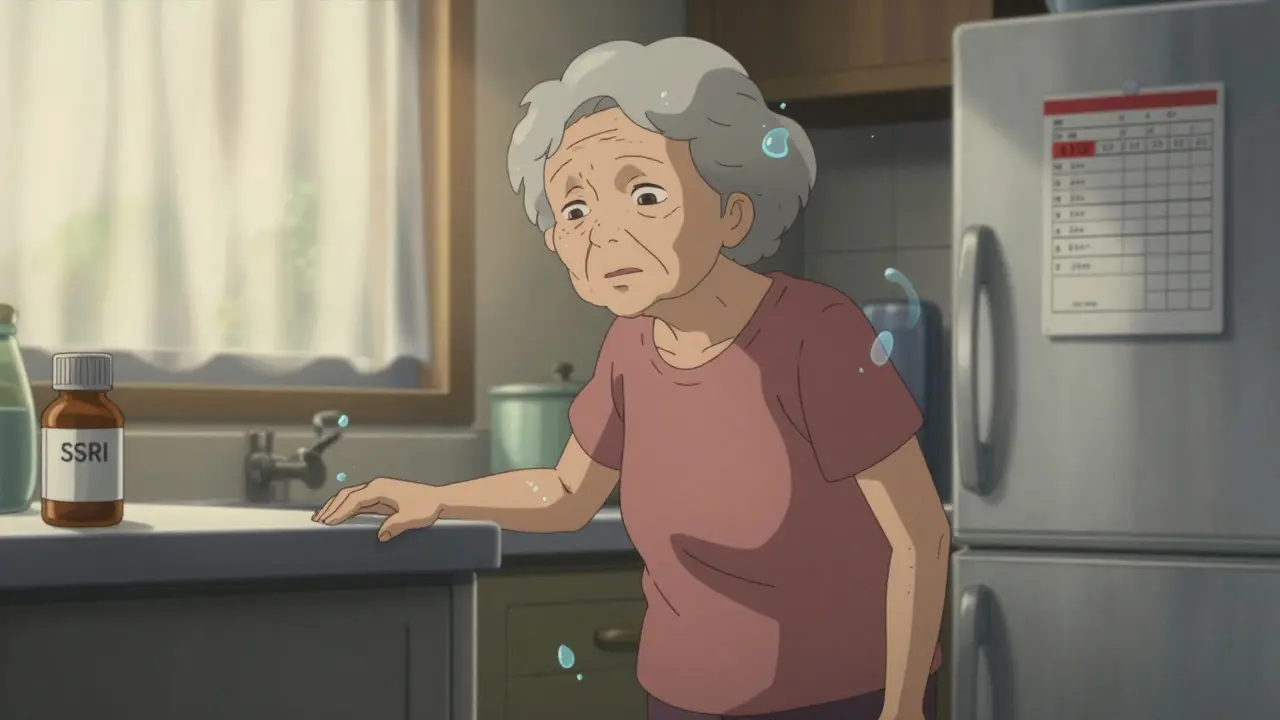
Every year, millions of older adults start taking SSRIs to manage depression or anxiety. These medications help many feel better-but they also come with quiet, dangerous risks that often go unnoticed until it’s too late. One of the biggest threats? hyponatremia. And when hyponatremia strikes, falls, fractures, and even hospitalizations aren’t far behind.
What Is Hyponatremia-and Why Should You Care?
Hyponatremia means your blood sodium level has dropped too low-below 135 mmol/L. It sounds simple, but in older adults, even a small drop can cause big problems. Sodium helps control fluid balance in your body. When it falls, your cells swell with water. In the brain, that swelling causes confusion, dizziness, weakness, and unsteady walking. These aren’t just "getting older" symptoms. They’re warning signs.
Studies show that older adults taking SSRIs are more than twice as likely to develop hyponatremia compared to those not on these drugs. About 6 out of every 100 seniors on SSRIs will see their sodium levels dip dangerously low. For some, it happens within weeks of starting the medication. And here’s the scary part: up to 40% of people with early hyponatremia feel perfectly fine. No nausea. No headache. Just a slow, silent decline in balance and clarity.
Why Are Older Adults More at Risk?
Your body changes as you age-and those changes make hyponatremia more likely. Older adults have less total body water. Kidneys don’t filter as well. The hormone that tells your body to hold onto water (ADH) can go haywire when SSRIs are in the system. This leads to a condition called SIADH-where your body keeps drinking in water even when it doesn’t need it, diluting your sodium.
Other factors stack the deck:
- Low body weight (BMI under 25)
- Starting sodium levels already near the low end (below 140 mmol/L)
- Taking a thiazide diuretic like hydrochlorothiazide at the same time
- Being female
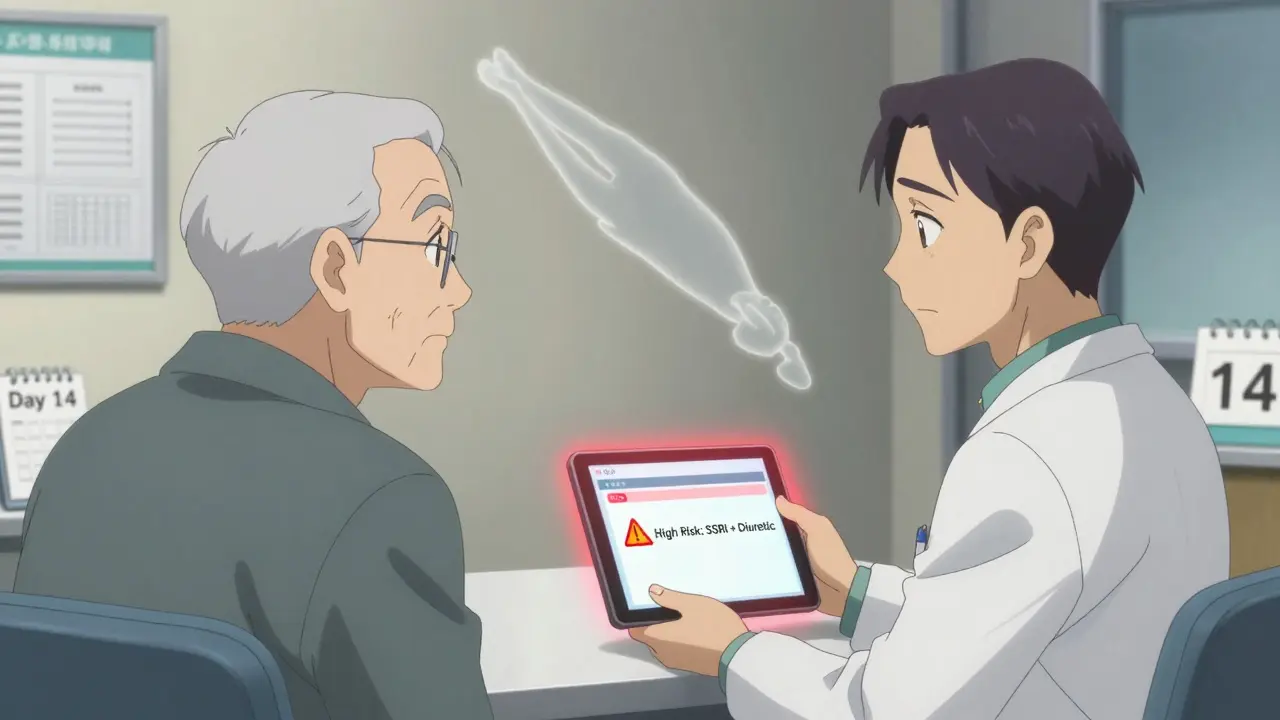
The combination of SSRIs and thiazide diuretics is especially dangerous. Research shows this pairing increases hyponatremia risk by 24% to 27%. Many seniors take diuretics for high blood pressure or swelling. If they’re also on an SSRI, they’re sitting on a ticking clock.
Which SSRIs Are Riskiest?
Not all SSRIs are created equal when it comes to hyponatremia risk. Some are much more likely to cause problems than others.
Fluoxetine (Prozac) carries the highest risk among SSRIs-nearly 3.6 times more likely to cause low sodium than other SSRIs. Sertraline (Zoloft) and escitalopram (Lexapro) are also common and carry moderate risk. Paroxetine (Paxil) and citalopram (Celexa) fall in the middle. But venlafaxine (Effexor), an SNRI often mistaken for an SSRI, is even worse-its risk is higher than most SSRIs.
On the flip side, mirtazapine (Remeron) and bupropion (Wellbutrin) are much safer options for older adults. Mirtazapine has almost no link to hyponatremia. Bupropion doesn’t affect sodium levels at all. Neither is a classic SSRI, but both are effective antidepressants. If you’re over 65 and just starting treatment, asking your doctor about these alternatives could be life-saving.
Falls Aren’t Just Accidents-They’re Symptoms
When an older adult falls, it’s often labeled as a "trip" or "bad luck." But in many cases, it’s the body screaming that something’s wrong inside. Hyponatremia causes dizziness, muscle weakness, and poor balance. These aren’t random. They’re direct effects of low sodium.
There’s no official statistic that says "X% of falls in seniors are caused by SSRIs," but the link is clear. Geriatricians see it every day: a patient starts an SSRI, begins stumbling, and then breaks a hip. By the time they’re in the ER, their sodium level is 122. The fall wasn’t the problem-it was the symptom.
That’s why doctors now recommend looking at fall history when choosing an antidepressant. If you’ve fallen before-even once in the last year-that’s a red flag. It doesn’t mean you can’t take an SSRI. But it means you need extra caution: baseline sodium test, follow-up in two weeks, and a plan to watch for early signs.
What Should You Do? A Practical Guide
If you or a loved one is starting an SSRI, here’s what actually works:
- Get a baseline blood test. Ask for a serum sodium level before the first pill is taken. If it’s already below 138, talk to your doctor about alternatives.
- Test again at two weeks. That’s when hyponatremia usually shows up. Don’t wait for symptoms. By then, it might be too late.
- Review all medications. Are you on a water pill? A diuretic? That combo is a known danger zone. Your doctor may need to switch the diuretic or adjust the SSRI.
- Know the warning signs. If you feel unusually dizzy, confused, weak, or unsteady on your feet-don’t brush it off. Call your doctor. Get sodium checked.
- Ask about safer options. Mirtazapine and bupropion are just as effective for many people and carry far less risk. Don’t assume SSRIs are the only choice.
Some clinics have started using automated alerts in their electronic records. When a doctor prescribes an SSRI to someone over 65 who’s also on a diuretic, the system pops up a reminder: "Check sodium in 14 days." Hospitals that use these tools have cut high-risk prescriptions by nearly 20%.

Why Routine Monitoring Isn’t Enough
Here’s the contradiction no one talks about: multiple guidelines say you should check sodium levels after starting SSRIs. But a major 2023 study found that hospitals doing routine testing didn’t see fewer hospitalizations for hyponatremia. So what’s going on?
The answer is simple: detecting the problem doesn’t fix it. If you find low sodium but don’t act-by stopping the SSRI, adjusting fluids, or switching meds-you’re just playing catch-up. Many doctors know the test is needed but don’t have time to follow up. Labs send results. No one calls the patient. The sodium keeps dropping. The fall happens.
Real prevention means more than a blood test. It means systems. It means accountability. It means training nurses, pharmacists, and caregivers to recognize the signs and respond fast.
What’s Being Done to Fix This?
Change is coming-slowly. The American Geriatrics Society now warns against SSRIs in older adults with existing hyponatremia or high fall risk. The FDA updated SSRI labels in 2022 to highlight this danger. And a new $2.8 million NIH study launched in September 2024 is trying to answer the biggest question: What monitoring plan actually saves lives?
Meanwhile, organizations like the Geriatric Antidepressant Safety Collaborative are building AI tools that look at your medications, past falls, lab results, and age to predict your risk. These tools could one day tell your doctor: "This patient has a 32% chance of developing hyponatremia in 30 days. Consider mirtazapine instead."
For now, the best defense is awareness. If you’re on an SSRI and over 65, don’t wait for a fall to happen. Ask for your sodium level. Ask about safer options. Ask what to watch for. Your balance, your safety, and your independence depend on it.
Can SSRIs cause falls in older adults?
Yes, indirectly. SSRIs can cause hyponatremia (low blood sodium), which leads to dizziness, weakness, and poor balance. These symptoms increase the risk of falls. Many falls in older adults on SSRIs are not accidents-they’re signs of an underlying chemical imbalance.
How soon after starting an SSRI can hyponatremia occur?
Hyponatremia usually develops within two to four weeks of starting an SSRI or increasing the dose. That’s why doctors recommend checking sodium levels at the two-week mark-before serious symptoms appear.
Are all SSRIs equally risky for seniors?
No. Fluoxetine (Prozac) carries the highest risk. Paroxetine, citalopram, and sertraline are moderate. Mirtazapine and bupropion are much safer alternatives with little to no risk of hyponatremia. Ask your doctor if a lower-risk option could work for you.
Should I stop my SSRI if I feel dizzy?
Don’t stop abruptly. Dizziness could be a sign of hyponatremia, but stopping an SSRI suddenly can cause withdrawal. Call your doctor right away. They’ll likely order a blood test to check your sodium level and guide next steps-whether that’s adjusting your dose, switching meds, or fluid management.
Is it safe to take a diuretic with an SSRI?
It’s risky. Combining thiazide diuretics (like hydrochlorothiazide) with SSRIs increases hyponatremia risk by over 25%. If you’re on both, ask your doctor to review your medications. There may be safer alternatives for blood pressure or swelling that don’t carry this danger.
What’s the safest antidepressant for older adults?
Mirtazapine (Remeron) is currently considered the safest option for older adults concerned about hyponatremia. It’s effective for depression and anxiety and has almost no link to low sodium. Bupropion (Wellbutrin) is another low-risk choice. Both are good alternatives to SSRIs, especially if you’ve had a fall or are on a diuretic.

Comments
Lori Anne Franklin December 27, 2025 AT 03:51
i started my mom on zoloft last year and she got super dizzy one day-thought she was just tired, but turns out her sodium was 128. scary stuff. we switched to mirtazapine and she’s been way more steady on her feet. don’t wait for a fall, folks.
Ryan Cheng December 28, 2025 AT 01:33
Great breakdown. One thing I’d add: if you’re on a thiazide diuretic and your doctor pushes an SSRI, push back. That combo is a silent killer. My uncle had two falls in six weeks-both after starting sertraline. Sodium was 129. He’s on bupropion now and hasn’t stumbled since. Ask for the test. Don’t assume it’s "just aging."
Also-mirtazapine isn’t perfect, but for seniors? It’s the quiet hero.
wendy parrales fong December 29, 2025 AT 13:19
my grandma took lexapro for a year and never said a word about feeling off-until she slipped in the shower. turned out her sodium was low. we didn’t know until the hospital did the bloodwork. now she’s on remeron and laughs again. if you’re older and on antidepressants, just ask for a sodium test. it’s easy. it could save your life.
Jeanette Jeffrey December 29, 2025 AT 18:28
why are we even prescribing SSRIs to people over 65? this isn’t a medical issue-it’s a systemic failure. doctors are lazy. they don’t want to spend time finding alternatives. they just hand out pills like candy. hyponatremia? falls? of course. you’re giving a 70-year-old a drug that makes their brain swell. what did you expect? stop pretending this is about mental health. it’s about profit and convenience.
Shreyash Gupta December 30, 2025 AT 04:45
lol why are you all so scared? i’m 68 and on citalopram + hctz for 3 years. sodium’s always 137. maybe you’re just weak? 🤷♂️
Ellie Stretshberry December 31, 2025 AT 12:32
my dad’s on prozac and i’ve been begging him to get his sodium checked but he says he feels fine so why bother… i’m so scared he’s gonna fall and no one will know why. please if you’re on these meds just get tested. even if you feel okay. please.
Zina Constantin December 31, 2025 AT 22:19
as someone who grew up in a family where mental health was never talked about, i’m so glad this info is out there. my aunt was misdiagnosed for years because her dizziness was called "old age." now she’s on mirtazapine and walks her dog every morning again. education saves lives. thank you for writing this.
Dan Alatepe January 2, 2026 AT 05:13
yo this hit different… my cousin died from a fall after starting zoloft. they didn’t even test his sodium till after he was in the ICU. he was 71. they said "it was just a slip" but we knew. it wasn’t luck. it was a slow poison. now i tell every senior i know: ask for the test. if they say no, go to another doctor. your life > their schedule.
Angela Spagnolo January 2, 2026 AT 20:48
...i just realized my mom’s on sertraline... and she’s on hydrochlorothiazide... and she’s had two falls this year... oh my god... i’m calling her doctor right now... please someone tell me it’s not too late...
Ryan Cheng January 3, 2026 AT 14:55
Update: I just called my mom’s PCP. They agreed to switch her from sertraline to mirtazapine. Bloodwork next week. I’m not waiting for another fall. If your doctor hesitates, ask for a pharmacist consult. They’re trained to catch these combos. And if they still push back? Find a new doctor. This isn’t optional.