
When you’re prescribed a bisphosphonate for osteoporosis, it’s not just about popping a pill. The real key to making it work lies in how you time your calcium supplement. Get it wrong, and you could be throwing away up to 90% of the drug’s effectiveness. This isn’t a minor detail-it’s the difference between preventing a fracture and ending up back in the hospital.
Bisphosphonates like alendronate, risedronate, and zoledronic acid are the backbone of osteoporosis treatment. They work by slowing down bone loss, targeting the cells that break down bone tissue. Studies show they cut the risk of spinal fractures by 40-50% and hip fractures by 20-25%. But none of that matters if the drug never gets into your bloodstream.
Why Calcium Ruins Bisphosphonate Absorption
Calcium is essential for bone health. But when it’s in your stomach at the same time as a bisphosphonate, it binds to the drug and forms a hard, insoluble complex. Think of it like mixing salt and oil-they don’t blend. Your body can’t absorb either properly.
Pharmacokinetic studies show that taking calcium within hours of a bisphosphonate can slash absorption by up to 90%. That’s not a small drop-it’s the difference between getting a full dose and getting almost nothing. This isn’t theory. It’s proven in clinical trials and confirmed by the International Osteoporosis Foundation and the Endocrine Society.
And here’s the kicker: most people don’t know this. A 2022 survey by the National Osteoporosis Foundation found that 40% of patients take calcium supplements right after or even with their bisphosphonate. That’s not just a mistake-it’s a treatment failure waiting to happen.
The Right Way to Take Them
There’s a strict, non-negotiable sequence:
- Take your bisphosphonate first thing in the morning, on an empty stomach, with a full glass of plain water.
- Wait at least 30 to 60 minutes before eating, drinking anything else (including coffee or orange juice), or taking any other medication-especially calcium.
- Stay upright (don’t lie down) for at least 30 minutes after taking the pill to avoid irritation.
- Take your calcium supplement later in the day, ideally with a meal. This helps your body absorb it better and reduces stomach upset.
This isn’t just advice. It’s the only way the drug works as intended. The Hospital for Special Surgery and Cleveland Clinic both state this clearly: no exceptions.
Why People Keep Getting It Wrong
It’s not that patients are careless. The regimen is confusing. You’re told to take a pill for your bones, and you’re also told to take calcium. It’s natural to assume they go together.
On Reddit’s r/Osteoporosis community, over 67% of users said they initially mixed up the timing. One user wrote: "I took my Fosamax and my calcium tablet together for six months before my doctor finally caught it. I felt like an idiot."
Even prescriptions can be misleading. Many patients get a bottle of bisphosphonate and a separate bottle of calcium, with no instructions on timing. No wonder adherence is so low.
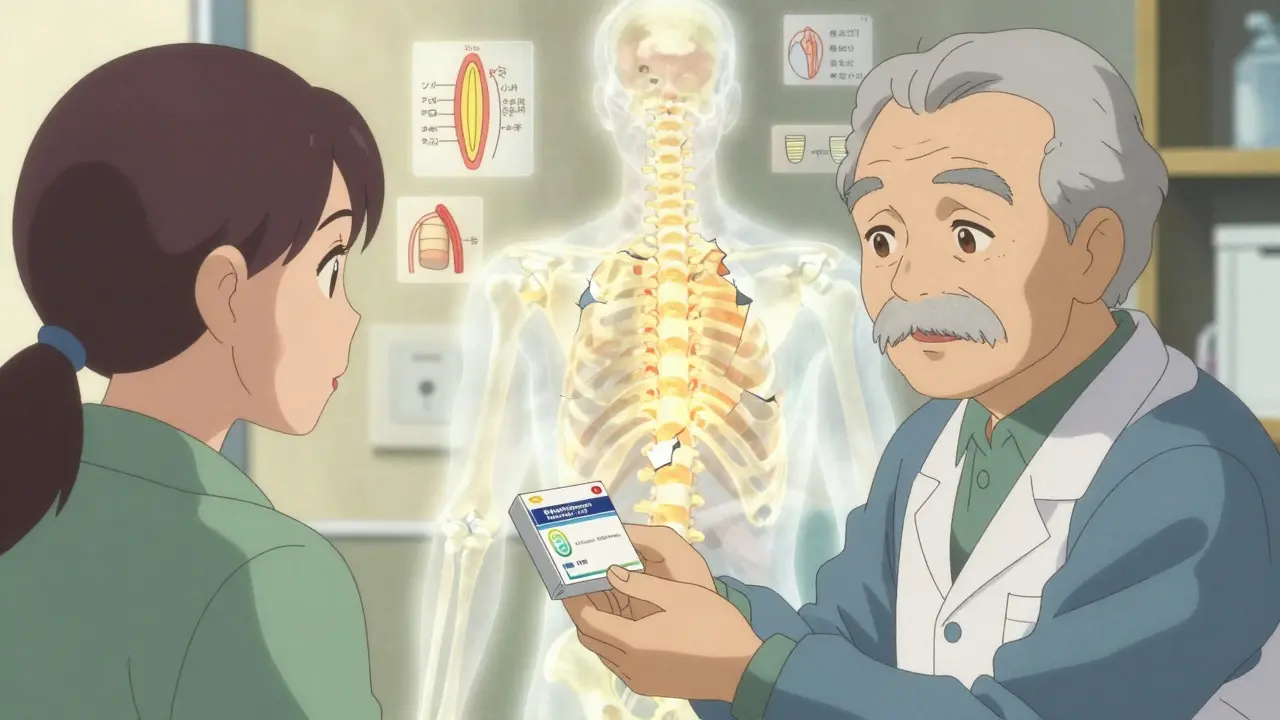
That’s why some manufacturers now offer combo packs-like Actonel with Calcium. These packages include one risedronate tablet and six calcium tablets in a weekly blister pack, with clear labels telling you when to take each. A 2006 study found that patients using these packs were 28% more likely to take their meds correctly. Reviews on Drugs.com show users giving it 4.2 out of 5 stars, mostly because "the system made it impossible to mess up."

How Much Calcium Do You Really Need?
Not too much. Not too little. Just right.
The American College of Rheumatology and the Endocrine Society agree: aim for 500-1,000 mg of supplemental calcium per day, on top of what you get from food. That’s usually one or two standard 500 mg tablets. Total daily calcium (diet + supplement) should not exceed 1,200 mg.
Why the limit? Because too much calcium might raise your risk of heart problems. Dr. Diane L. Schneider from UC San Diego points to studies linking calcium supplements over 1,200 mg/day to a slight increase in cardiovascular events. That doesn’t mean stop taking it. It means don’t overdo it.
And don’t forget vitamin D. Your body needs it to absorb calcium. Experts recommend 800-1,000 IU daily. If you’re not getting enough sun or eating fatty fish, you’re probably deficient.
The Bigger Picture: Fractures vs. Side Effects
Some people worry about rare side effects like jaw bone damage (osteonecrosis) or unusual thigh bone fractures. These are real-but extremely rare.
The number of people you need to treat with bisphosphonates to prevent one hip fracture is 44 over three years. The number you need to treat to cause one case of jaw bone damage? Between 10,000 and 100,000. That’s a 200- to 2,000-fold difference.
And here’s what most people don’t realize: one in five people who break a hip die within a year. That’s not just a statistic-it’s a real, devastating outcome for families. Dr. Ethel Siris at Columbia University puts it plainly: "The risk of a fracture is far greater than the risk of a side effect."
That’s why doctors don’t stop prescribing bisphosphonates. They just want you to take them right.
What If You Forget or Mess Up?
Life happens. You oversleep. You take your pill with breakfast. You forget and take calcium right after.
If you accidentally take calcium with your bisphosphonate, don’t panic. Don’t double up tomorrow. Just skip the bisphosphonate that day and resume your normal schedule the next morning. Never take two doses to "make up" for a missed one.
Same goes if you forget your bisphosphonate. If it’s an oral one (like alendronate), take it the next morning on an empty stomach. Don’t take it midday. The window is strict. If you miss your weekly dose, take it the next day and go back to your original schedule. No doubling up.
Real Talk: Adherence Is the Biggest Hurdle
Studies show that 58% of people stop taking bisphosphonates within a year. Why? Three main reasons:
- Stomach upset (31%)
- Thinking it’s not working (28%)
- Too hard to manage timing with other meds (23%)
The last one is the most fixable. If you’re struggling with timing, ask your pharmacist about combo packs. Or set phone alarms: one for your bisphosphonate, another for your calcium. Use pill organizers with labeled sections.
And if you’re still confused, ask your doctor for a written schedule. Don’t rely on memory. Write it down. Tape it to your bathroom mirror. Your bones will thank you.
Final Rule: No Shortcuts
Bisphosphonates aren’t like blood pressure pills or statins. You can’t take them with food, with coffee, or with calcium. There’s no flexibility. The science is clear: timing is everything.
If you’re on a bisphosphonate, treat your calcium like a separate medication-with its own time, place, and ritual. Do this right, and you’re giving yourself the best shot at avoiding a fracture. Do it wrong, and you’re wasting a powerful tool.
It’s not about being perfect. It’s about being consistent. One mistake won’t ruin everything. But repeated mistakes? That’s when your bones start paying the price.

Comments
Andy Cortez February 7, 2026 AT 12:51
So let me get this straight-you’re telling me I’ve been wasting my money on calcium for YEARS because I took it with my Fosamax? I’m not even mad, I’m impressed. My doctor never mentioned this. My pharmacist didn’t mention this. Even the pamphlet said 'take with water' and left it at that. Now I feel like I’ve been played by Big Pharma AND my own bone health. 😭
Joseph Charles Colin February 8, 2026 AT 02:09
The pharmacokinetic interaction between bisphosphonates and divalent cations like calcium is well-documented in the literature. The formation of insoluble chelates in the gastric lumen significantly reduces oral bioavailability, as evidenced by AUC and Cmax reductions exceeding 80% in multiple randomized crossover trials. This is not anecdotal-it’s Class I evidence. The 30–60 minute fasting window is non-negotiable for therapeutic efficacy.
Randy Harkins February 9, 2026 AT 00:09
I just want to say thank you for writing this. I’ve been on alendronate for 3 years and honestly thought I was doing great until I read this. I’ve been taking my calcium at night with dinner and it’s made all the difference. My last DEXA scan showed improvement! You’re right-timing matters. I wish more doctors explained this like you did. 🙏
Tori Thenazi February 10, 2026 AT 23:41
Wait… so… are you saying the FDA, the AMA, and Big Pharma are deliberately hiding this? Because if calcium interferes with bisphosphonates, why aren’t they forced to put warning labels on BOTH bottles? And why do combo packs even exist if they’re just a band-aid? I’ve seen this pattern before-remember the Vioxx scandal? This smells like a cover-up. Someone’s making money off our confusion.
Frank Baumann February 12, 2026 AT 05:48
I’ve been taking Actonel for five years now, and I swear I’ve done everything right-empty stomach, upright posture, water only, wait an hour. But I still get this gnawing stomach pain. I thought it was just the drug. But what if… what if I’ve been taking my calcium too close? I take it at 8 AM with my coffee and toast. I’ve been doing it for years. Is that why I still feel like I’m crumbling inside? I need to know. I need to fix this. My knees are starting to click now. I don’t want to end up in a wheelchair.
Alex Ogle February 14, 2026 AT 03:22
I read this and just sat there. Quiet. Didn’t move. Didn’t breathe. Because I’ve been doing it wrong. Not just a little wrong. Like… every single day for 4 years. I take my pill right after brushing my teeth, then grab my calcium tablet and swallow both. No water. Just chug. I thought it was efficient. Turns out I was just giving my bones a middle finger. I feel like I’ve been sleepwalking through my own health. I’m resetting my whole routine tonight.
Brandon Osborne February 15, 2026 AT 17:54
You people are pathetic. You let corporations tell you when to take your pills? You think some study in a journal means anything? I’ve been taking my calcium and bisphosphonate together since 2018. I’m 72. I still hike. I still lift. I don’t need your science. I need my own experience. You’re all just scared of your own shadows. The real problem? You’re too lazy to build real bone strength. Go lift weights. Eat real food. Stop relying on pills and pamphlets.
Lyle Whyatt February 16, 2026 AT 21:02
I’m from Australia and we’ve had the same guidelines here for over a decade. The Therapeutic Goods Administration even released a video series on this exact issue. I’ve been a pharmacist for 20 years and I still see people mixing calcium with their meds. It’s wild. The combo packs are a game-changer-simple, clear, no thinking required. My wife uses them. She’s 68. Last year, she didn’t have a single fall. That’s not luck. That’s smart management.
Random Guy February 17, 2026 AT 01:06
Lmao so you’re telling me I’m not supposed to take my osteoporosis pill with my morning smoothie? I put calcium powder, kale, banana, and my Fosamax in a blender. Thought I was being healthy. Turns out I was just making bone soup. My bones are probably mad at me.
Chelsea Cook February 17, 2026 AT 11:24
I’m a nurse and I’ve seen so many patients give up on these meds because they ‘don’t feel anything.’ But this? This is the kind of info that saves lives. I printed this out and taped it to the wall in my clinic. I tell every patient: ‘Your calcium isn’t your enemy. Your timing is.’ You’re not just giving advice-you’re giving people back their independence.
John Sonnenberg February 19, 2026 AT 08:23
This article is dangerously oversimplified. You ignore the fact that bisphosphonates have a half-life of over 10 years in bone tissue. The absorption window is not as rigid as you claim. The 90% loss figure is cherry-picked from single-dose studies. Real-world adherence is messy. People aren’t robots. You’re creating unnecessary anxiety over a pharmacokinetic nuance that rarely impacts long-term outcomes. Stop scaremongering.
Jessica Klaar February 21, 2026 AT 01:02
I’m Nigerian-American and my mom took Fosamax for 7 years. We didn’t know any of this. She took calcium with her pill because that’s what her Nigerian doctor told her. She had a hip fracture at 74. I’ve been reading everything I can since then. This article? It’s the missing piece. I’m sharing it with my whole family. Thank you for writing this. We needed to hear it.
PAUL MCQUEEN February 21, 2026 AT 02:24
I’m not saying this isn’t important. But have you looked at the cost? Bisphosphonates are expensive. Combo packs? Even more. Insurance won’t cover them. So now you’re telling people to spend more money on a system they didn’t ask for? Meanwhile, I’ve got patients who can’t afford to eat. This feels like a luxury solution for people who already have access to care.
Chima Ifeanyi February 22, 2026 AT 23:59
The entire premise is flawed. Bisphosphonates are not ‘bone builders.’ They’re bone-preserving agents with long-term risks. The real solution is vitamin K2, magnesium, and resistance training. Calcium supplementation is a 1980s relic. Modern osteoporosis management doesn’t rely on calcium pills-it relies on hormonal balance and mechanotransduction. You’re propagating outdated dogma under the guise of science.