
When patients move from hospital to home, or from one care setting to another, their medications often get mixed up. A pill that was stopped in the ER might still be on the discharge list. A new blood pressure drug might clash with an old one they’ve been taking for years. These errors aren’t just mistakes-they lead to trips back to the hospital. In fact, pharmacist-led substitution programs have been shown to cut 30-day readmissions by up to 22% in high-risk patients. But how do they actually work-and why are they becoming the gold standard in medication safety?
What Exactly Is a Pharmacist-Led Substitution Program?
It’s not just about swapping one drug for another. A pharmacist-led substitution program is a structured process where trained pharmacists review every medication a patient is taking, compare it to what’s documented in the system, and make evidence-based changes to improve safety and effectiveness. This happens during key transitions: admission to hospital, discharge, or transfer to a nursing home.
Pharmacists don’t guess. They use verified medication histories-often gathered by trained technicians-to find discrepancies. On average, each patient has 3.7 errors in their medication list when first reviewed. These aren’t minor oversights. They’re dangerous mismatches: wrong doses, discontinued drugs still listed, or dangerous combinations like mixing blood thinners with NSAIDs.
The goal? Replace non-formulary drugs with cheaper, safer alternatives approved by the hospital. Stop medications that no longer help-especially in older adults. And make sure patients leave with a clear, accurate list they can actually follow.
How These Programs Are Built
Successful programs aren’t run by one person working overtime. They’re teams. In a busy hospital, you’ll typically see one pharmacist managing 3-4 medication history technicians. These technicians are trained to interview patients, check pill bottles, call pharmacies, and input data into the electronic health record. They handle the grunt work-collecting lists, verifying dosages, flagging inconsistencies.
The pharmacist then steps in. They don’t just approve substitutions. They decide: Is this beta-blocker still needed after a heart attack? Should we drop this anticholinergic that’s causing confusion in an 80-year-old? Can we replace this expensive insulin with a biosimilar that works just as well?
Training matters. Technicians complete at least two hours of classroom instruction and five eight-hour supervised shifts before working alone. After training, they achieve 92.3% accuracy in medication history collection. That’s not luck-it’s protocol.
These programs run 7 a.m. to 8 p.m. in most hospitals. In trauma centers, they’re on 24/7. The timing isn’t arbitrary. It’s designed to catch patients at the moment they’re most vulnerable: right after admission, before they’re given new meds, and again before discharge.
Why Pharmacists? Not Nurses or Doctors
Doctors are busy. Nurses are stretched thin. But pharmacists? They’re the only clinicians trained to know every drug interaction, every dosing guideline, every alternative on formulary. A 2023 review of 123 studies found that 89% of programs led by pharmacists reduced readmissions-compared to just 37% of those led by other staff.
Take the OPTIMIST trial. It compared two groups: one got a simple medication review. The other got a full pharmacist-led intervention-medication reconciliation, education, follow-up calls, and substitution recommendations. The result? A 38% lower risk of being readmitted within 30 days. That’s not a small win. It means one in every 12 patients avoided a hospital return because of this service.
And it’s not just about drugs. It’s about understanding patients. A pharmacist will ask: “Do you have trouble opening these bottles?” “Can you afford this insulin?” “Do you take your pills with food or on an empty stomach?” These aren’t yes-or-no questions-they’re life-or-death.
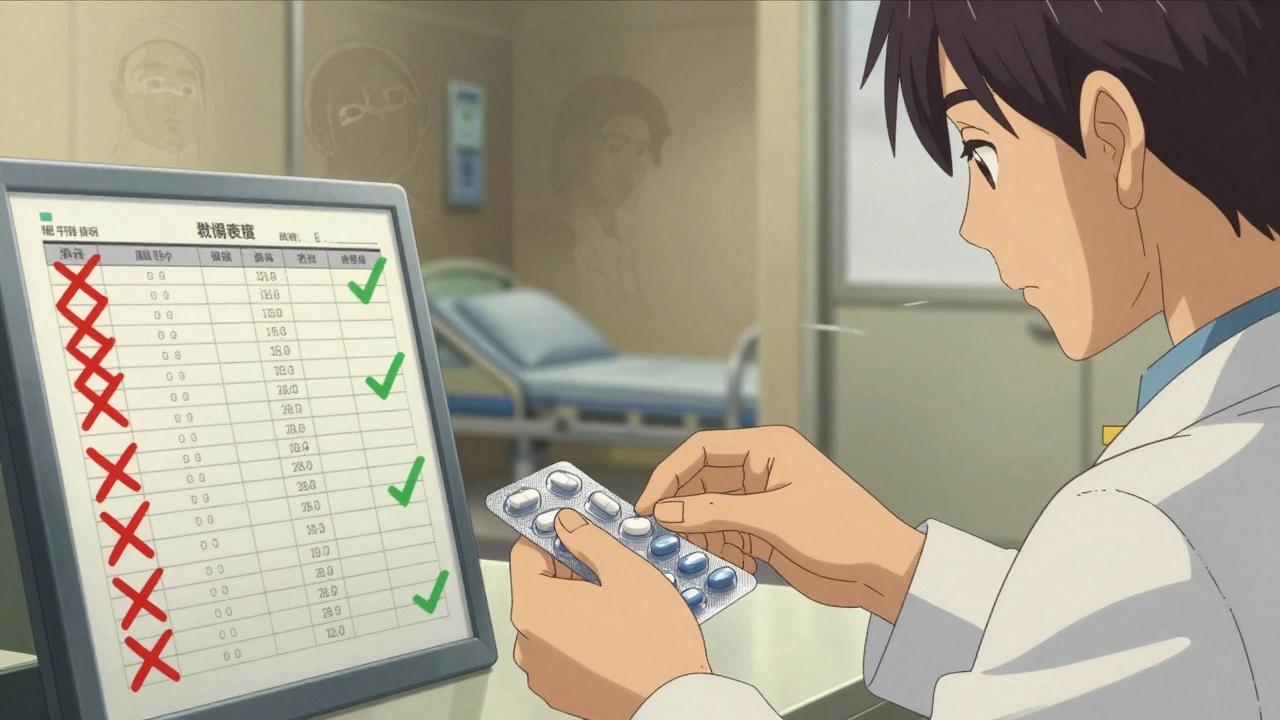
Deprescribing: The Hidden Game-Changer
One of the most powerful parts of these programs is deprescribing. That’s the deliberate stopping of medications that no longer help-or that cause more harm than good.
In elderly patients, it’s common to see five, six, even ten prescriptions. Some were started years ago. Some are for symptoms that have resolved. Many are anticholinergics-drugs that cause dizziness, confusion, and falls. A 2023 study showed that when pharmacists deprescribed these in nursing homes, falls dropped by 41%.
Proton pump inhibitors (PPIs) are another target. These acid reducers are often prescribed long-term, even when not needed. Stopping them reduces C. difficile infections by nearly 30%. But doctors rarely initiate this. Pharmacists do.
In one program, 52% of pharmacist recommendations focused on stopping medications. The catch? Only about 30% of those were accepted by physicians. That’s the biggest hurdle-not the science, but the culture.
Barriers and How They’re Being Overcome
Despite the data, these programs still face resistance. Forty-three percent of academic hospitals report physician pushback. Why? Some feel pharmacists are overstepping. Others don’t trust the data. Many just don’t have time to review recommendations.
Smart programs solve this with technology. Electronic health records now auto-flag when a patient is on a non-formulary drug. The system suggests a substitute. The doctor gets a pop-up: “Patient on pantoprazole. Suggested switch to generic omeprazole. Same efficacy, 80% cheaper.” That’s not a request. It’s a decision support tool.
Time is another issue. A full reconciliation takes about 67 minutes per patient. That’s a lot in a crowded ER. The fix? Split the work. Technicians collect data. Pharmacists focus on clinical judgment. Documentation time dropped to just 12.7 minutes per patient once this model was adopted.
Reimbursement is still messy. Only 32 states fully pay for these services under Medicaid. Medicare Part D covers them for 28.7 million beneficiaries-but the paperwork is brutal. Still, the financial payoff is clear: $1,200 to $3,500 saved per patient by preventing avoidable hospitalizations.
Where the Field Is Headed
The future is digital. AI tools are now being tested to pull medication histories from multiple pharmacies, insurance claims, and patient portals. One pilot cut data collection time by 35%. That’s huge.
And the scope is expanding. By 2023, 42% of skilled nursing homes had pharmacist-led deprescribing programs-up from 18% in 2020. The 2022 federal law requiring medication reconciliation for all Medicare Advantage patients created a $420 million market opportunity.
Even rural hospitals are catching on, though slowly. Only 22% of critical access hospitals have full programs, compared to 89% in urban academic centers. Pharmacist shortages are the main barrier. But telepharmacy is starting to fill the gap.
Most importantly, value-based care is driving adoption. Sixty-three percent of Accountable Care Organizations now include pharmacist-led substitution metrics in their performance contracts. Hospitals aren’t just doing this because it’s good practice-they’re doing it because their payments depend on it.
The Bottom Line
Pharmacist-led substitution programs aren’t a nice-to-have. They’re a safety net. They turn medication errors from a silent killer into a solvable problem. The data doesn’t lie: fewer readmissions, fewer falls, fewer infections, and lower costs.
What makes them work isn’t magic. It’s structure. It’s training. It’s collaboration. And it’s recognizing that pharmacists aren’t just dispensers of pills-they’re the last line of defense before a patient walks out the door with a dangerous mix of medications.
If your loved one is heading to the hospital, ask: “Will a pharmacist review their meds?” If the answer is no, push for it. Because in healthcare, the most dangerous thing isn’t a missing drug-it’s the one you didn’t know you were still taking.

Comments
Courtney Black December 8, 2025 AT 12:54
They say pharmacists are just pill pushers. But when your grandma ends up back in the ER because they forgot to stop her old antipsychotic, you realize they’re the only ones paying attention.
It’s not about saving money. It’s about not killing people with outdated prescriptions.
And yeah, I’m mad this isn’t mandatory everywhere.
iswarya bala December 10, 2025 AT 04:42
omg this is so true!! i had my dad on 7 meds and no one ever checked if he still needed em… then he started falling all the time. pharmacist caught 4 that were totally unnecessary. he’s been walking like a human again since. thank u for sharing!! 🙏
Simran Chettiar December 10, 2025 AT 08:54
One cannot help but observe that the systemic undervaluation of pharmaceutical expertise reflects a deeper epistemological hierarchy within modern medicine-a hierarchy that privileges diagnostic authority over pharmacological nuance.
It is not merely a logistical oversight; it is a metaphysical misalignment wherein the custodians of therapeutic integrity are relegated to administrative periphery.
When the physician’s judgment is elevated above the pharmacist’s evidence-based recalibration, we are not merely tolerating error-we are institutionalizing iatrogenesis.
Deprescribing is not an intervention; it is a reclamation of clinical sovereignty.
And yet, the cultural inertia persists, rooted in the myth of the omniscient physician, a relic of pre-industrial medicine.
The data is irrefutable. The outcomes are quantifiable. The resistance is emotional, not rational.
It is not the pharmacist who oversteps-it is the physician who refuses to acknowledge the limits of his own domain.
Perhaps the true crisis is not in medication errors-but in our collective refusal to cede authority to those who have been trained to see what others overlook.
Until we restructure the hierarchy of care, we will continue to bury our mistakes under the weight of pride.
And still, the pills keep coming.
Philippa Barraclough December 12, 2025 AT 07:03
The OPTIMIST trial’s 38% reduction in readmissions is statistically significant, but I’m curious about the generalizability across socioeconomic strata.
How many of those patients had access to follow-up care, stable housing, or consistent pharmacy access?
The model works beautifully in urban academic centers with dedicated staff, but what about rural clinics with one part-time pharmacist and no technicians?
And the 52% recommendation acceptance rate by physicians-what proportion of those were overridden due to habit rather than clinical reasoning?
It’s not enough to show efficacy. We need to understand the friction points in implementation.
Also, the 67-minute reconciliation time seems unsustainable without structural support.
Is there any data on burnout rates among pharmacists running these programs?
And how many of these interventions are being tracked beyond 90 days?
Reduction in readmissions is a great metric, but are we also measuring quality of life, cognitive function, or patient-reported outcomes?
It’s easy to celebrate the wins. The real challenge is sustaining them.
Tim Tinh December 13, 2025 AT 23:51
bro i had a cousin who got discharged with 11 meds and no one told her half of them were stopped in the hospital.
she took them all for 3 weeks straight. ended up in the psych ward from the benzos.
pharmacist saved her life. literally.
why aren’t we just doing this for everyone??
it’s not that hard. just talk to the patient. check the bottles. duh.
Olivia Portier December 15, 2025 AT 08:39
THIS. I’ve seen this firsthand with my mom. She’s 82, has 8 chronic conditions, and every time she goes to the hospital, her meds get shuffled like a deck of cards.
Then the pharmacist finally sat down with her, asked if she could open the bottles, if she could afford the insulin, and if she even knew why she was taking half of them.
She cried. Not because she was sick-but because someone finally cared enough to ask.
We treat meds like magic bullets, not part of a person’s life.
Pharmacists don’t just fix errors-they restore dignity.
And if your hospital doesn’t have this, demand it. Your loved one deserves better.
Tiffany Sowby December 16, 2025 AT 20:51
So let me get this straight-we’re paying pharmacists to do doctors’ jobs now?
Next they’ll be reading X-rays and writing prescriptions.
It’s not that I’m against pharmacists. It’s that I’m against mission creep.
And why are we always blaming doctors? Maybe the patients just don’t follow directions.
Also, why is this only in the US? In Europe, they just give you a pill and hope for the best. Works fine.
Asset Finance Komrade December 18, 2025 AT 14:03
One must question the ontological framing of this narrative: Is the pharmacist truly the 'last line of defense,' or are we merely projecting onto them the failures of a fractured, profit-driven system?
Are we not, in fact, outsourcing institutional negligence to overworked clinicians who are themselves cogs in a machine?
AI-driven reconciliation may reduce data collection time, but does it reduce the alienation of care?
And let us not mistake cost savings for moral progress.
The $3,500 saved per patient? That’s the cost of not having a social safety net.
What if the real solution isn’t better pharmacists-but fewer people needing hospitalization in the first place?
Until we address housing, nutrition, and access to primary care, this is just triage dressed as innovation.
Still. The pills are interesting.
Jennifer Blandford December 19, 2025 AT 02:24
My uncle was on a PPI for 12 years. No one ever asked why. Then the pharmacist said, ‘You haven’t had heartburn since 2018.’ He stopped it. No acid reflux. No weird stomach cramps. Just… normal.
And now he’s out gardening every morning.
That’s not medicine. That’s magic.
Pharmacists are the quiet superheroes we don’t know we need.
So if you’re reading this and your hospital doesn’t have this program?
Go scream at someone. Loudly. With glitter.